The Malawi Government has launched a nationwide payroll and personnel audit supported by the World Bank and the European Commission (EC) to curb a rapidly rising wage bill and eliminate systemic payroll fraud.
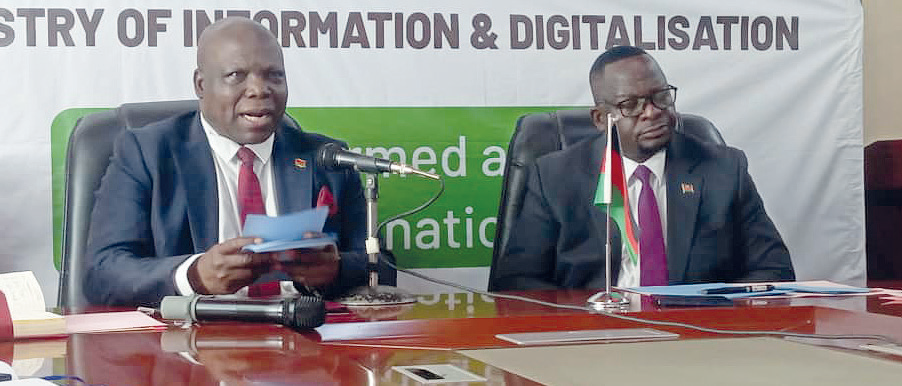
Briefing the media in Lilongwe on Friday, Minister of Information and Communications Technology Shadric Namalomba said the wage bill has surged from K479.6 billion in the 2021-22 financial year to a projected K1.6 trillion by 2025-26, consuming 25 percent of recurrent expenditure and 38 percent of all domestic tax revenue.
“This trajectory is untenable. For every K100 paid in tax by our citizens, K38 is allocated to salaries,” he said.
Namalomba said while recruitment in critical sectors and cost-of-living adjustments account for part of the rise, government can no longer ignore weaknesses such as outdated records, ghost workers and role duplication.
“These leaks are eroding discipline, betraying public trust and draining resources that should be building roads and stocking clinics,” he said.
Taking his turn, Chief Secretary to the Government Justin Saidi announced that the said audit seeks to reconcile Human Resource Management Information System (HRMIS) establishments with the physical verification of every public worker.
“This is the foundational step towards eliminating ghost workers, payroll irregularities and systemic inefficiencies,” he said.
The Comprehensive Personnel Audit of All Public Servants Drawing Remuneration from Public Funds is scheduled to run from December 9 2025 to February 6 2026 with the first phase targeting the ministries of Education, Health, Agriculture, Local Government as well as all security organs and district councils.
According to Saidi, all employees are required to present themselves in person and provide original documents, including IDs, certificates and appointment letters.
“The public servants’ personal appearance is compulsory and any failure to appear will result in immediate suspension of salary,” he said.
Payroll audits are not new in the Malawi public service with the recent one held in 2020. In October and November 2015, government also embarked on a similar exercise to delete ghost workers through a headcount and payroll audits conducted by the National Audit Office (NAO). The ghost workers were said to be inflating government’s wage bill.
An audit undertaken by NAO in August 2017 found that ghost workers were still common in ministries of Health, Agriculture, Irrigation and Water Development, Education, Science and Technology and Natural Resources and Mining.